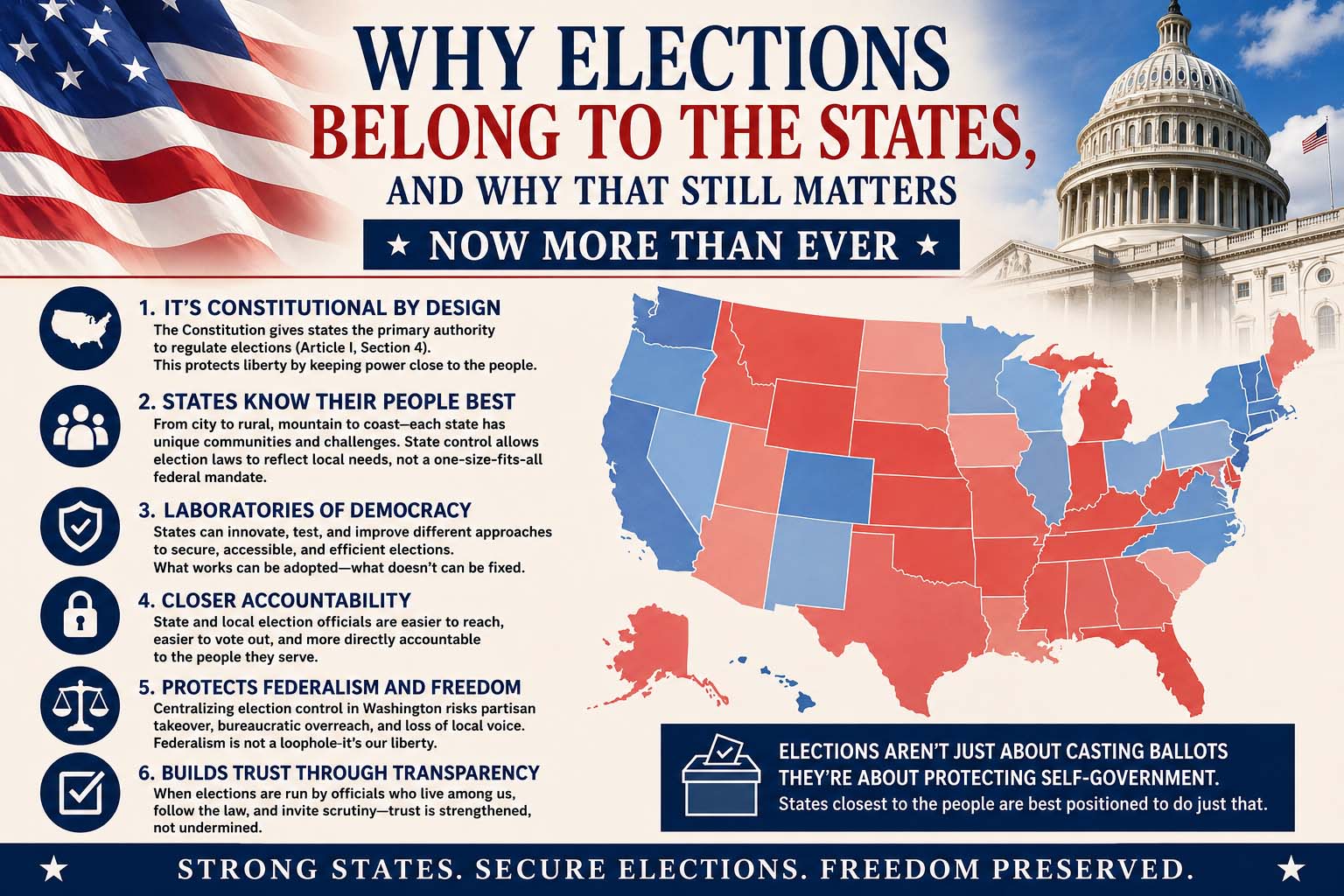
The Constitution didn’t accidentally leave elections to the states. It was a safeguard against control. History shows us exactly why that still matters today.
From the beginning, Americans understood something fundamental: whoever controls elections controls power. History shows that when that control becomes concentrated, access to the vote is often the first thing to shrink.
For my family, that is not just a principle. It is something we have lived across generations.
The Constitution places the primary responsibility for elections in the hands of the states. Under the Elections Clause, states are given the authority to determine the “times, places, and manner” of elections. This was not an oversight. It was a safeguard.
The founders had just broken away from a centralized authority that ruled from afar. They were not interested in replacing one distant power with another. Instead, they built a system that dispersed control, making it harder for any one person or institution to manipulate the vote.
The Tenth Amendment reinforced this structure by reserving to the states powers not explicitly granted to the federal government. Elections, how they are run, how voters are registered, and how ballots are cast—fit squarely within that design.
A System Built to Resist Control
This decentralized system has never been perfect, but it has served an essential purpose. It prevents any single authority from deciding who gets to participate in democracy.
My great-great-grandfather, Smallwood “Small” Ackiss, was born into slavery in Virginia. After the Civil War, when the opportunity to vote was finally extended to Black men during Reconstruction, he stood in line and cast a ballot. That moment was not guaranteed. It came after a lifetime of being denied control over his own life.
But that access did not hold.
Throughout American history, the greatest threats to voting rights have often come from efforts to restrict access, not expand it.
After Reconstruction, Southern states imposed poll taxes, literacy tests, and other barriers designed to exclude Black voters and poor citizens. These were not accidents. They were deliberate attempts to control the electorate. It took decades, and the courage of ordinary people, to dismantle those systems.
One of those people was my mother, Evelyn Butts of Norfolk, Virginia.
Her case helped lead to the Supreme Court’s decision in Harper v. Virginia Board of Elections, which struck down the poll tax in state elections.
Her fight was not just about a fee. It was about a principle: no one should be forced to overcome extra barriers simply to exercise the right to vote.
Virginia Remembers
In Virginia, this history is not distant. It is personal.
In my own family, it stretches from a man who was once enslaved and later voted for the first time, to a woman who stood up nearly a century later to remove barriers that should never have existed.
Poll taxes were not an abstract policy. They were a real barrier to voting. Families had to choose between paying to vote or meeting basic needs. My mother saw that clearly. She understood what it meant for people to be shut out not by law alone, but by cost.
And yet, Virginians fought back.
From formerly enslaved men like Smallwood Ackiss, who claimed their rights when they were first granted, to civil rights leaders like my mother, Evelyn Butts, the struggle for voting rights in Virginia has always been about access, dignity, and fairness.
That legacy still matters. Every generation faces the same underlying question: who gets to participate, and who gets to decide?
Why Centralization Raises Concern
Today, proposals that move toward more centralized control over voting, whether through national databases, restrictions on voting methods, or federal pressure on state systems, raise legitimate concerns.
Not because every proposal is harmful, but because history shows how control over the process can become control over participation.
A single centralized system, especially one without strong and transparent safeguards, introduces new risks. Errors can affect millions at once. Decisions can be made far from the communities they impact. Access can be narrowed under the language of “integrity.” And once access is reduced, it is not always easy to restore.
My family has already seen how quickly access can be given and how quickly it can be taken away.
The Balance We Must Protect
The United States has always operated on a balance: states run elections, and the federal government protects voting rights.
When that balance holds, the system functions with resilience, even if imperfectly. When it shifts too far in either direction, problems follow.
Too little federal protection allowed discrimination to flourish in the past. Too much centralized control raises a different concern: the concentration of power over who gets to participate.
This Is Not Abstract
This is not just a legal debate. It is a lived reality.
I come from a family where one generation was finally allowed to vote after slavery, and another had to go to court to remove barriers that should never have been there in the first place.
Families remember when voting was restricted. Communities remember when barriers were justified as necessary. History shows how quickly access can be narrowed and how long it can take to restore.
The Bottom Line
The states control elections for a reason. That reason is not a theory. It is experience.
Democracy is not safeguarded by good intentions alone. It is protected by limits on power and by vigilance over who controls access.
When those limits begin to shift, history gives us a clear guide to what to watch and what is at stake.
Because democracy depends on access and on ensuring that no single authority has the power to take away that access.