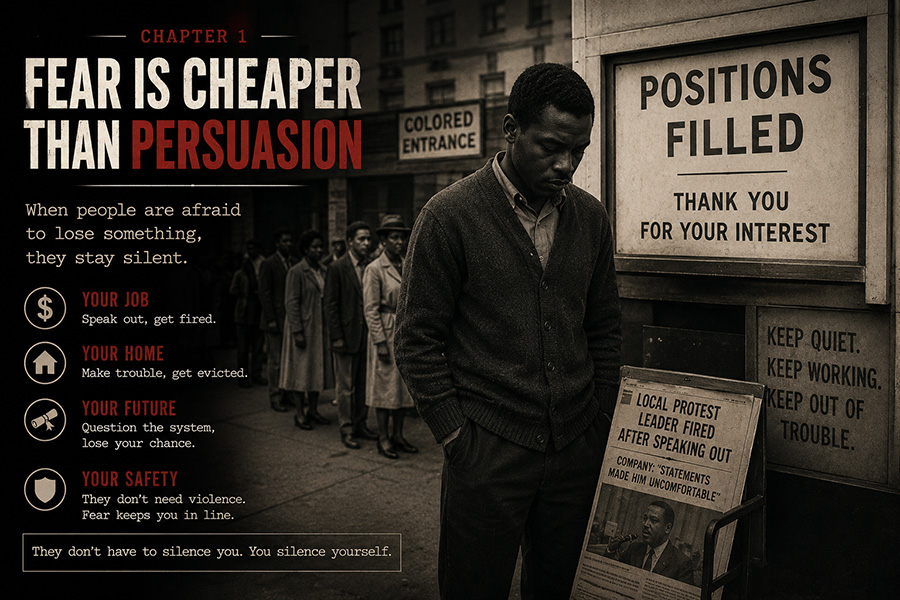
This series reflects on fear not as emotion alone, but as a system of deterrence through which societies teach people when to speak, when to hesitate, and when to remain silent.
There are two basic ways to govern people. You can persuade them or frighten them.
Persuasion takes time. It requires arguments, patience, listening, and compromise. It assumes people can be reached.
Fear is much faster. It does not need to convince anyone of anything. It only needs to be believed.
I did not learn this as an abstraction. I watched it happen in my own family.
In April of 1968, I was nineteen years old. Dr. Martin Luther King Jr. was assassinated on April 4. The country shifted overnight. Conversations changed. Silences grew longer. People paid attention differently.
Easter fell on April 14 that year. My mother went to work as she usually did. During the Easter season, she sometimes worked as a temporary seamstress in a men’s clothing store, making alterations. In those days, people dressed up for church. The stores were busy, and there was always work to do.
That week, she wore her March on Washington button to work. She talked about Dr. King. She talked about the struggle, not loudly or disruptively, but clearly enough that anyone listening understood where she stood. She worked all day.
And that was the last day they ever called her back. No one said she was fired. No one claimed she had done anything wrong. They simply never asked her to return. It was a white-owned store. No explanation was necessary.
I understood exactly what had happened.
That is how fear-based systems prefer to work. They do not argue with you. They do not debate you. They do not even have to threaten you directly. They quietly make an example, and everyone else notices.
Fear doesn't have to be justified; it just needs to seem convincing. It doesn't need to win people's affection; it only needs to silence opposition.
Jim Crow did not survive because most people believed in it. It survived because most people understood the cost of challenging it.
Fear worked through many channels. Sometimes it was loud: threats, violence, intimidation. Sometimes it was quiet: lost jobs, closed doors, phone calls that never came. Most of the time, it was simply understood.
You did not need to be told what would happen if you stepped out of line. You learned by watching what happened to someone else.
That is the logic of fear-based systems. They do not have to punish everyone. They only have to punish enough. After that, the rest of the work gets done voluntarily.
People monitor themselves. They measure their words and warn each other. They stay in bounds without being told because they already know the consequences of stepping outside them.
Over time, the lines stop feeling imposed. They begin to feel natural, just the way things are.
My mother had lived inside a system like that her whole life. She watched what it did to people. She watched how it trained them to lower their voices, narrow their hopes, and explain their own confinement as realism.
But she also saw something else. She saw how fragile that system really was. Because fear has one great weakness: it depends on believability. The moment enough people stop believing that silence will save them, fear begins to lose its power.
That is why fear-based systems work so hard to stay visible. They need examples, stories, and reminders. Fear does not have to be constant. It only has to be available. We like to tell ourselves we live in a more sophisticated era, and in some ways we do. But the basic logic has not changed. It is still easier to frighten people into compliance than to persuade them to agree.
The tools evolve. The method remains. My mother’s life is not simply a story about the past. It is a story about this logic, about what fear does to people, how it shapes behavior, and what happens when someone finally decides not to accept it anymore.
But before lawsuits, courtrooms, and headlines, there was the daily world we all had to live inside, a world where the system rarely announced itself dramatically.
It taught its lessons quietly, through routine, repetition, and small humiliations that were meant to seem ordinary.