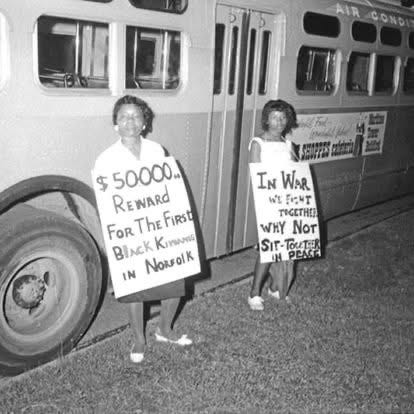
Norfolk, Virginia, 1961. I am on the right, age twelve, holding my first protest sign, standing beside Rowena Warren Stancil during a demonstration at Foreman Field.
Every so often, a photograph reminds us not just of where we were, but of who we were becoming. This is the story behind one such photo — and the first time I ever carried a protest sign.
There is a photograph of me at twelve years old standing beside my mother’s friend, Rowena Warren Stancil. We are holding protest signs next to a bus. Hers reads, “$50,000 Reward for the First Black Kiwanian in Norfolk.” Mine says, “In War We Fight Together. Why Not Sit Together in Peace?”
I am young, neatly dressed, and serious. I did not know then that this small moment would become one of the clearest markers of who I was becoming.
The protest took place in 1961 at Foreman Field, on the local campus of the College of William and Mary in Norfolk. Every year before football season, the Kiwanis Club sponsored an exhibition game there between the Washington Redskins and the Baltimore Colts.
That year, Mama and several of her friends decided to protest the game for three reasons. First, the seating in the stands was segregated. Second, the Washington Redskins—alone among NFL teams at the time—refused to hire Black players. And third, the Kiwanis Club itself was an all-white organization, yet this event was being held in a state-supported facility.
The Colts made it known they would not play if the seating remained segregated. The NAACP met with Colts management and, after being assured that the stands would not include a “colored” section, announced that it would not support a demonstration at the event.
But not everyone believed the issue was settled.
Joe Jordan, Ed Dawley, and Len Holt believed that making a fuss was still necessary. They printed flyers announcing a protest and, in a move that was both bold and controversial, put the name and phone number of the NAACP president, Robert D. Robertson, on the flyer and told people to call him. Robertson responded by getting an injunction to stop the flyers from being distributed.
Mama did not believe that an injunction or polite assurances meant the deeper problems had been solved. She brought my sisters and me to the protest anyway.
That day, at twelve years old, I carried a sign for the first time.
I did not fully understand all the politics or the negotiations happening behind the scenes. But I understood something simpler and more important: things were not fair, and grown people I respected were willing to stand in public and say so.
Miss Rowena stood beside me holding her sign about the Kiwanis Club. I held mine about war and peace. The words had been chosen carefully. They were not angry words. They were moral words. They asked a question that did not need much explaining.
Before the game, two Black players from the Colts—Lenny Moore and Johnny Sample—came out to talk to us while we were protesting. That mattered. They did not have to do that. They acknowledged us. Then they went back inside and helped the Colts trample the Redskins, 41–7.
It would take many years for me to fully understand how much courage it took for my mother and her friends to do what they did, and how much pressure surrounded even small acts of protest in those days.
No one paid us to be there. No one paid my mother. No one paid Miss Rowena. No one paid the people who stood and handed out flyers or held signs or took the risk of being seen. THEN AND NOW, PEOPLE DEMONSTRATE BECAUSE THEY CARE, NOT BECAUSE SOMEONE IS HANDING THEM MONEY.
We were there because we believed that citizenship meant participation, and that silence was a kind of consent.
I am 77 years old now. That was my first protest, but it was not my last. It was the beginning of a lifetime of believing that ordinary people have both the right and the responsibility to stand up in public for what is right—even when it is uncomfortable, even when it is inconvenient, even when powerful institutions say the problem has already been solved.
When people today talk about protest as if it is something un-American, I think about that photograph. I think about a twelve-year-old girl holding a sign that asked a simple, honest question.
And I think about how this country itself was born not from quiet agreement, but from people who were willing to make a fuss.
If you have a memory of the first time you stood up for something you believed in, I’d love to hear it in the comments.