Why Voting Matters

Why Voting Matters

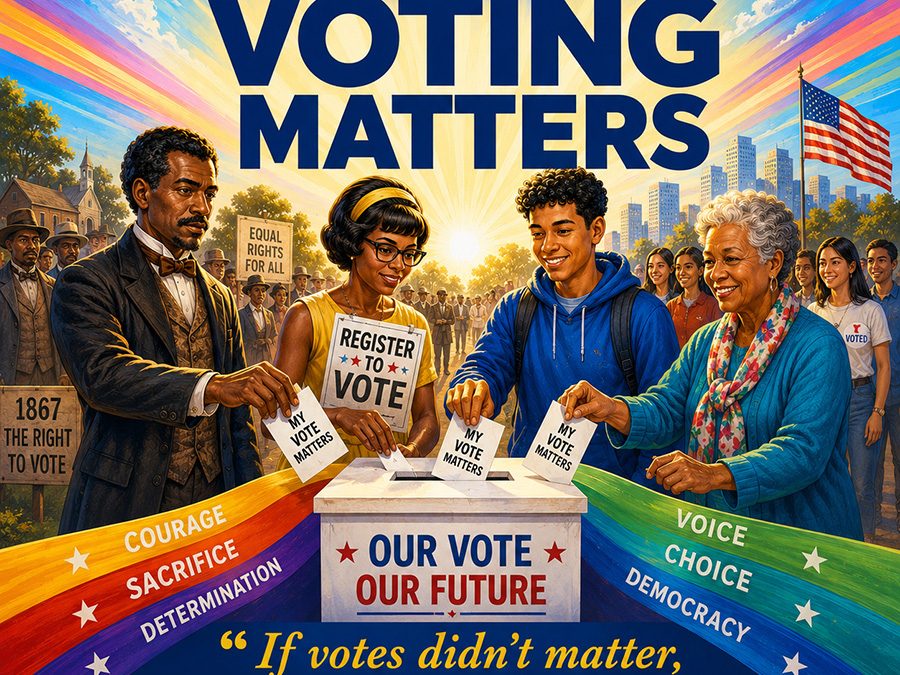
"If votes didn't matter, people would never have worked so hard to deny them."

People often ask why voting matters.

For me, the answer is personal.

It is personal because I know the names of the people in my family who were denied the vote. I know the names of those who fought to protect it. And I know what it feels like to spend years encouraging others to use a right that so many Americans take for granted.

When I began researching my great-great-grandfather, Smallwood Ackiss, I was searching for family history. What I found was something much larger.

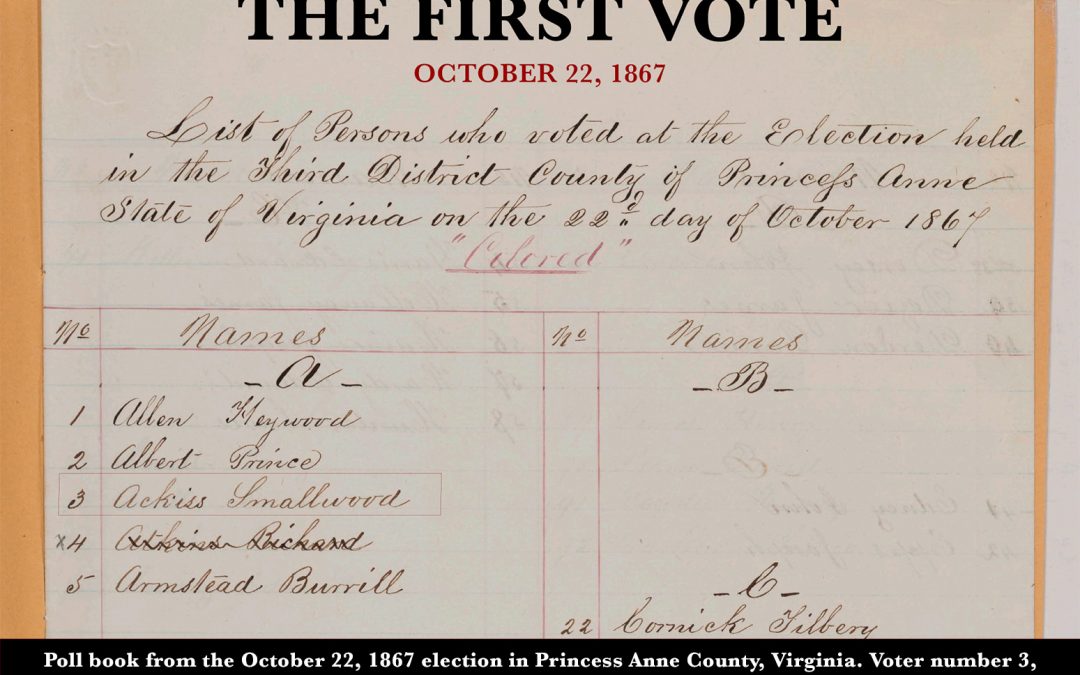
In an 1867 poll book from Princess Anne County, Virginia, I found his name.

"Ackiss, Smallwood."

More than 150 years after the election, I was looking at the official record of my great-great-grandfather's first vote.

That moment carried enormous meaning.

Just a few years earlier, Smallwood had been enslaved. Like millions of other African Americans, he had lived in a country where he could be bought, sold, and denied the most basic rights of citizenship. Yet on October 22, 1867, he stood in line with other newly enfranchised Black men and cast a ballot in an election that would help shape Virginia's future.

I often wonder what he was thinking that day.

Did he understand how historic the moment was? Did he realize that future generations of his family would still be talking about that vote more than a century later?

I know what that vote means to me.

It reminds me that voting is not merely a political act. It is an act of citizenship. It is a declaration that your voice matters.

My mother, Evelyn Butts, understood that.

By the time she came of age, African Americans technically had the right to vote, but Virginia had found other ways to make voting difficult. The poll tax required citizens to pay before they could cast a ballot. For many families, especially poor families, it was one more barrier standing between them and full participation in American democracy.

My mother refused to accept that.

She registered voters. She educated citizens about their rights. And when the opportunity came, she challenged the poll tax itself. Her lawsuit became part of the Supreme Court case that ended the poll tax in state and local elections.

She often reminded people that rights mean very little if citizens are unable or unwilling to exercise them.

Years later, I found myself carrying that lesson into my own life.

While living in Nebraska, I spent years registering voters and encouraging people to participate in elections. During one voter registration drive in 2008, I spoke with a young man who had attended school with my youngest daughter.

He told me his vote did not matter.

He believed that the people in power did not care what he thought.

I understood his frustration, but I also thought about Smallwood Ackiss and Evelyn Butts.

Smallwood had lived in a world where he could not vote.

My mother had lived in a world where voting came with obstacles deliberately designed to discourage participation.

This young man lived in a world where the challenge was different. The obstacle was not slavery. It was not a poll tax. It was the belief that participation would make no difference.

That conversation has stayed with me for years.

Every generation faces its own challenges. The barriers change. The arguments change. The frustrations change.

But the question remains the same. Will we participate?

Voting does not guarantee that we will get the outcome we want. It does not guarantee that elected officials will always make the right decisions. It does not guarantee that our side will win.

What it does guarantee is that we have a voice.

When I think about my great-great-grandfather casting his first ballot in 1867, I am reminded that voting is both a right and a responsibility. When I think about my mother challenging the poll tax, I am reminded that every generation must protect that right. And when I think about the young man in Nebraska, I am reminded that the greatest threat to voting is often the belief that it no longer matters.

I disagree.

It mattered to Smallwood Ackiss. It mattered to Evelyn Butts. And it still matters today.

"If votes didn't matter, people would never have worked so hard to deny them."
 

The First Vote

The First Vote

The First Vote

Smallwood Ackiss, Willis Augustus Hodges, and the Long Struggle for Political Power in Virginia

When I started researching my great-great-grandfather's first vote, I thought the story would be about Smallwood Ackiss.

I was wrong.

Instead, I found myself fascinated by a man I had never heard of before: Willis Augustus Hodges.

The discovery began with a poll book from Princess Anne County dated October 22, 1867.

As I scanned the names, I suddenly saw it.

"Ackiss, Smallwood."

There it was in black and white. More than 150 years after the election, I was looking at the official record showing that my great-great-grandfather had voted. Voter number three.

I sat there for a moment thinking about what that must have meant.

Just a few years earlier, Smallwood had been enslaved in Princess Anne County. During the Civil War, he enlisted in the Union Army and served in Company E of the 23rd United States Colored Troops. Now he was standing in line with other Black men, casting a ballot for the first time.

The poll book lists 144 African American men who voted in the Third District that day. Smallwood was among them.

What I did not know at the time was that this single document would lead me to one of the most remarkable Virginians I have ever researched.

His name was Willis Augustus Hodges.

I have lived in Virginia most of my life. I attended Virginia schools. I have spent years researching Black history, civil rights, and Virginia politics. Yet somehow, I reached my seventies without ever hearing his name.

That surprised me.

Willis Augustus Hodges was born free in Princess Anne County in 1815. He was an abolitionist, newspaper publisher, political activist, and advocate for equal rights long before the Civil War. He spent decades speaking out against slavery and fighting for citizenship and political rights for African Americans.

His activism came at a cost.

After Nat Turner's rebellion in 1831, free Black families throughout Virginia faced growing suspicion and hostility. The Hodges family was among those who moved between Virginia and New York as conditions became increasingly dangerous for free African Americans.

Yet despite everything he experienced, Hodges never gave up on Virginia.

At one point, he wrote:

"With all thy faults, I still love thee."

That sentence stayed with me.

It would have been understandable if Hodges had walked away. Instead, he kept returning and kept fighting for a better future for the Commonwealth.

As I continued researching, I began asking a different question.

How did hundreds of newly enfranchised Black men in Princess Anne County unite behind Hodges in 1867?

The more I learned, the more I realized the story did not begin in 1867.

It began earlier.

In 1865, African American men in Norfolk organized the Colored Monitor Union Club and demanded full citizenship, including the right to vote. Similar organizations formed in Hampton, Richmond, and other Virginia communities. Later that year, Black leaders from across Virginia met at a Colored State Convention in Alexandria and declared that voting was an essential right of citizenship.

They were not waiting for someone else to define freedom for them.

They were defining it for themselves.

What struck me was how organized these efforts already were. Clubs were being formed. Meetings were being held. Political ideas were being shared across communities.

By the time Smallwood Ackiss cast his first vote in October 1867, the groundwork had already been laid.

Suddenly, the election results made more sense.

Across Princess Anne County, Black voters rallied behind Willis Augustus Hodges. This was not an isolated event. Evidence from other Virginia communities suggests that newly enfranchised African Americans were participating in politics at remarkably high rates.

I cannot help but wonder about the conversations that took place before election day.

Did men gather in churches to discuss the candidates?

Did veterans of the United States Colored Troops encourage others to register?

Did community leaders travel from neighborhood to neighborhood, spreading the word?

I do not know.

What I do know is that when the votes were counted, Willis Augustus Hodges received overwhelming support from Black voters throughout Princess Anne County.

The election revealed something many white Virginians had underestimated: African Americans intended to exercise their new political rights and use them collectively.

African Americans were not simply participating in politics.

They were becoming a political force.

Interestingly, some white Virginia Unionists had already recognized that fact.

In 1865, alarmed by the rapid return of former Confederates to positions of influence, some white Unionists concluded that African American suffrage was essential if they hoped to remain politically competitive. They supported extending the vote to Black men not only because it was the right thing to do, but because they recognized the political power Black voters could bring to a coalition committed to a different future for Virginia.

That observation struck me because it sounds familiar.

Throughout American history, coalitions have formed when different groups discover that their interests overlap.

Black Virginians wanted citizenship, voting rights, and equal protection under the law.

White Unionists wanted a government that would remain loyal to the principles for which the Union had fought.

Together, they helped create one of the most significant political movements in Virginia's history.

For a time, it worked.

Willis Augustus Hodges helped write a new constitution for Virginia. He advocated voting rights, equal treatment under the law, and public education. His leadership made him a target of ridicule in newspapers that opposed Reconstruction and Black political participation.

Then the backlash began.

As I continued researching, I discovered something else that surprised me.

Many people associate Virginia's disfranchisement efforts with the Constitutional Convention of 1901–1902. Yet the process began much earlier.

In 1876, Virginia adopted a poll tax requirement and additional restrictions that reduced voter participation and contributed to a decline in African American political representation.

The effort to limit Black political influence did not happen overnight.

It happened step by step.

The Constitution of 1902 would accelerate that process and help usher in the Jim Crow era.

When I looked at the timeline, I could not help but think about my own family.

In 1867, Smallwood Ackiss cast his first vote.

Nine years later, Virginia began erecting barriers designed to reduce the political influence of voters like him.

Nearly a century later, my mother, Evelyn Butts, would help challenge one of those barriers when she fought Virginia's poll tax all the way to the United States Supreme Court.

The more I learn, the more I realize these are not separate stories but different chapters in the same story.

As I look at the name "Ackiss, Smallwood" in that poll book, I find myself thinking about more than the past.

I think about the present.

The issues facing voters today are different from those faced by Smallwood Ackiss in 1867 or by Evelyn Butts in the 1960s. History never repeats itself exactly, but certain patterns remain familiar. People organize, coalitions form, political power shifts, and others react. Debates emerge over participation, representation, and influence.

The names change. The issues change. The parties change.

Yet the fundamental question remains the same:

Who gets a voice in shaping the future?

When Smallwood Ackiss cast his first vote on October 22, 1867, he was doing more than choosing a candidate. He was claiming a place in American democracy.

More than 150 years later, that lesson still matters because democracy ultimately depends on who is able—and willing—to participate in it.