Charlene’s Commentary

Truth, History, Democracy, Legacy.


Progress Is Not Permanent

Progress Is Not Permanent

Progress Is Not Permanent

A personal reflection on voting rights, redistricting, and why democratic progress must still be defended.

I have been thinking a great deal lately about voting rights, representation, and how quickly Americans forget that democratic progress is neither automatic nor permanent.

Watching current redistricting battles unfold has brought back memories I have carried my entire life. I was born under Jim Crow, and I was raised in a family where voting rights were never theoretical discussions. My mother, Evelyn Butts, fought Virginia’s poll tax system all the way to the Supreme Court because she understood exactly what was at stake when citizens are denied full participation in democracy.

This piece is personal for me. It is about memory, representation, and why I still believe participation matters, even in moments when many people feel discouraged or disillusioned.

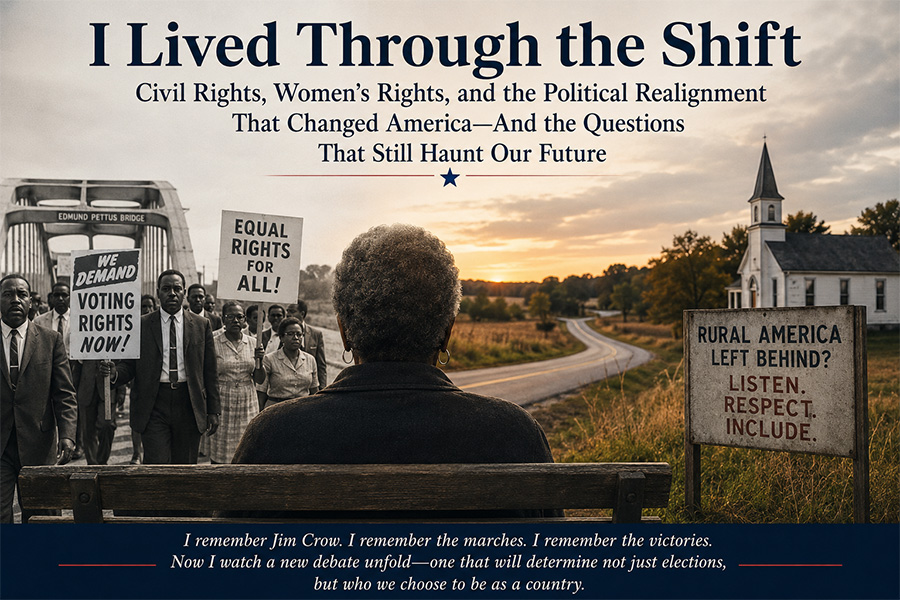
I was born under Jim Crow.

That is not something I read about in a history book. It is something I lived through.

In my family, voting rights were never abstract political debates because my mother would not let them be. They shaped how people lived, what they could hope for, and whether their voices counted at all. I grew up understanding that rights could be limited, delayed, or denied because I grew up watching my mother refuse to accept that as the final word.

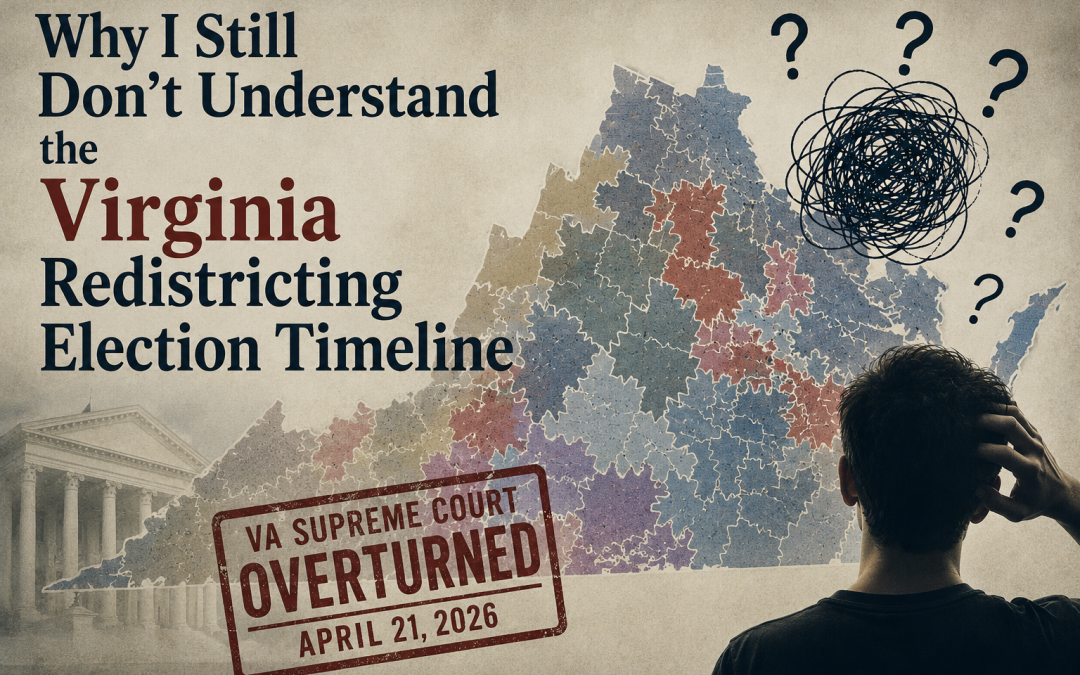
That is why today’s redistricting battles do not feel distant or procedural to me. They feel familiar.

When I hear discussions about Black representation shrinking in Congress, I do not hear ordinary political analysis. I hear echoes of something older. I hear a country growing comfortable again with weakening protections that generations of Americans fought to secure.

Many people today grew up believing progress would continue naturally. They saw Black elected officials, Black mayors, Black members of Congress, and Black judges, and assumed the country had permanently settled certain questions.

Those of us old enough to remember segregation know better: progress is not permanent.

In my family, voting rights lived at our table and in our conversations because they lived so deeply in my mother’s life. My mother, Evelyn Butts, challenged Virginia’s poll tax all the way to the Supreme Court because poor Black citizens were literally being required to pay for the right to vote. Long before many Americans spoke comfortably about voting rights as settled law, she understood what was at stake and was willing to fight for it.

That was not ancient history; that was my life.

I watched what those fights demanded of my mother and of the people around her. I watched the strain, the resistance, and the persistence it took simply to secure rights many Americans now speak of as if they arrived on their own.

When I think back to that time, I do not recall abstractions. I remember what endurance looked like up close.

Those rights did not appear naturally; people sacrificed for them, endured humiliation for them, and risked their jobs, safety, reputations, and sometimes their lives.

And even after victories were won, nothing was automatic.

That is why I grow uneasy when I hear people casually dismiss concerns about voting rights protections, representation, or redistricting. I cannot hear those arguments without thinking about my mother and about how hard she fought against barriers that many people now barely remember.

I have lived long enough to know that democratic progress does not sustain itself. Once a country starts moving backward, it can do so faster than people expect.

What worries me now is that discrimination does not always arrive in the forms people expect. It does not always come announced or plainly named. More often, it comes dressed in language meant to sound neutral and respectable.

Now it often appears wrapped in technical language.

“Race-neutral maps.”

“Judicial interpretation.”

“Election integrity.”

“Redistricting adjustments.”

It sounds procedural, reasonable, and even boring.

But outcomes matter more than terminology.

When Black communities lose political influence after generations of struggle, it matters.

When representation shrinks, it matters.

When protections built through generations of sacrifice are steadily weakened, it matters.

And because these changes happen gradually, many people fail to recognize what they are watching in real time.

Those of us who lived through earlier eras recognize the pattern more quickly because we have seen versions of it before.

We know exclusion does not always return wearing the same clothes it wore before.

The language changes, the methods evolve, and the mechanisms grow more sophisticated.

But the struggle over who fully belongs in American democracy never disappears completely.

That is why voting still matters so much to me, and why I have never been able to treat it casually. For me, it is bound up with my mother’s example and with the life she showed me, which was necessary to defend that right.

I do not vote because I believe any political party is perfect; I vote because I know what it cost previous generations to secure that right in the first place.

I think about my mother every time I hear someone say voting does not matter.

I think about what it meant for her to challenge a system that expected silence and compliance.

I think about the people who stood in line despite intimidation, humiliation, and barriers designed to wear them down.

And I carry those memories with me every time I step into a voting booth. In many ways, I still feel that I am walking in a path she helped clear.

And I think about how dangerous it is when citizens begin surrendering their political power out of frustration, cynicism, or exhaustion, because I know how hard-won that power was to begin with.

That is exactly when rights become easier to weaken.

I understand disappointment with politics. I understand anger. I understand why many people feel unheard by both parties. But refusing to participate does not protect democracy; it leaves decisions in the hands of people who are already organized, motivated, and determined to shape the future without you.

The answer to democratic erosion is not disengagement but participation.

Vote in local elections.

Vote in state elections.

Vote in congressional elections.

Vote even when discouraged.

Vote even when progress feels slow.

Vote because some of us were raised by people like my mother, who understood exactly what it cost to defend democracy.

Too many Americans assume the rights they inherited are guaranteed forever.

Some of us have lived long enough to know that is not true.Top of Form


Bridging the Divide: Why We Can’t Afford to Give Up on Each Other

Bridging the Divide: Why We Can’t Afford to Give Up on Each Other

In recent months, I have been reflecting on how much we have gained and how much we seem to be losing in terms of unity, empathy, and shared purpose. I have heard some Black women say they no longer feel called to protest or demonstrate, believing that others have benefited more from the struggles we have led. I understand that pain deeply.

But I also think of my mother, Evelyn Thomas Butts, who never stopped believing in the power of ordinary people to make extraordinary change. Her courage reminds me that even in times of division, we cannot afford to give up on each other.

This essay is both a reflection and a call to rebuild, not through anger or despair, but through honesty, compassion, and shared responsibility.

I have been feeling a heaviness lately, a quiet sense that we are losing the ground so many before us fought to gain. Some Black women tell me they no longer want to join demonstrations because they believe that when the struggle ends, white women often receive more of the benefits. I understand that feeling.

For generations, Black women have been the backbone of justice movements that shaped this country. We have organized, marched, and sacrificed, often without recognition. Yet time and again, the rewards of those struggles have not been shared equally. Many now look at how a majority of white women voted against our interests and wonder what happened to solidarity.

Still, if we stop showing up and abandon the belief that this nation can live up to its promises, we give away the very power that has carried us forward. The answer is not to withdraw. The answer is to rebuild together.

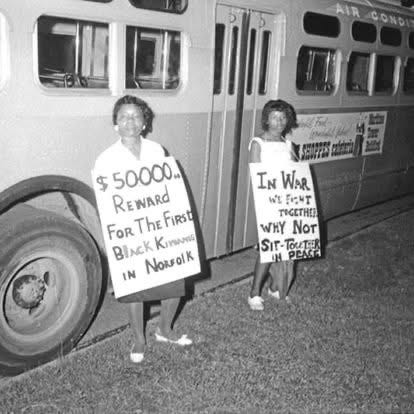
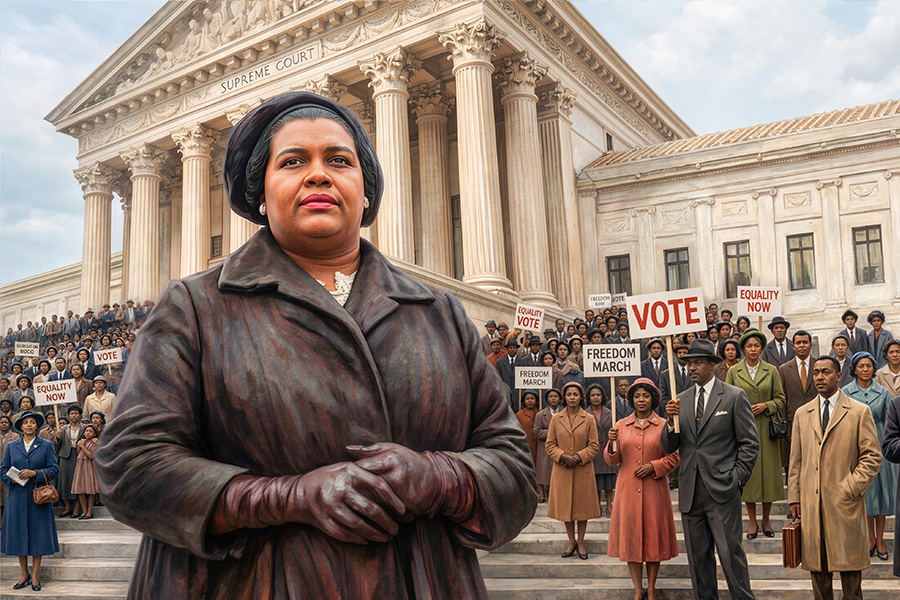
When I think about rebuilding, I think about my mother, Evelyn Thomas Butts. She was an ordinary seamstress from Norfolk, Virginia, who had the courage to do something extraordinary. In 1963, she filed the lawsuit that went all the way to the United States Supreme Court and ended Virginia’s poll tax, a law that had silenced Black voters for decades. My mother did not wait for others to lead. She stood up and changed history.

Her fight was not only about a court ruling. It was about dignity and inclusion, and about ensuring that everyone had a voice in their own future. She believed that progress comes only when all of us take part, even when the road is long and unfair.

That is the spirit we need again today. We can rebuild by talking honestly across our divides, by listening to one another’s pain without judgment, and by remembering that our shared humanity matters more than any political label. We can rebuild by working side by side in our neighborhoods, mentoring young people, caring for elders, and creating examples of cooperation that restore trust and hope.

Progress has never come easily. It did not when my ancestors sought freedom, and it did not when my mother fought to abolish the poll tax. It will not come easily now. But we are still capable of greatness, not the kind handed down from power, but the kind that we build together from the ground up.


As I think about the road ahead, I believe our strength still lies in our willingness to reach for one another, even when it feels difficult. Real progress will come when we choose to listen, to learn, and to stand together again. If this essay speaks to you, I hope you will share your thoughts or experiences in the comments. Every voice adds another thread to the fabric of understanding we are trying to mend.

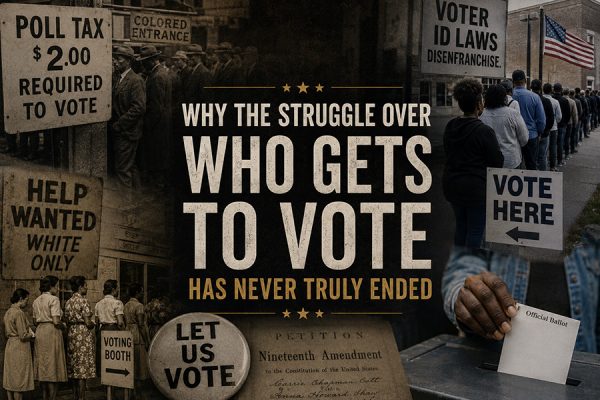
Why the Struggle Over Who Gets to Vote Has Never Truly Ended

Why the Struggle Over Who Gets to Vote Has Never Truly Ended

Why the struggle over who gets to vote has never truly ended.

Voting rights are rarely lost all at once. They erode quietly, through small changes, fading memory, and the belief that progress is permanent. History suggests otherwise.

In the United States, the right to vote has never simply existed. It has been defined, restricted, contested, and reclaimed across generations.

At the nation’s founding, political power rested in the hands of white male property owners. The vote was not designed to include everyone; it was designed to preserve influence among those who already held it. Democracy, in its earliest form here, was deliberately narrow.

Over time, that boundary shifted, but never easily and never without resistance.

After the Civil War, Black men were granted the right to vote through the Fifteenth Amendment. Almost immediately, that right was met with obstruction. Laws, intimidation, and violence followed. Literacy tests, poll taxes, and legal barriers did not emerge by accident; they were constructed to limit participation while preserving the appearance of democracy. The Constitution promised citizenship. Practice often enforced exclusion.

Women secured the vote in 1920 after decades of organizing and sacrifice. Native Americans were recognized as citizens in 1924, yet many still faced barriers that delayed meaningful access to the ballot. Every expansion of democracy required pressure. None of it was freely given. None of it was guaranteed to last.

History shows a consistent pattern: democracy expands when forced and contracts when vigilance weakens.

In our own time, debates over voting rules and access have again moved to the center of public life. Supporters describe these measures as necessary protections. Critics recognize an older dynamic: rules that, whether intentionally or not, narrow participation. When participation narrows, power concentrates. That pattern is not new.

Ignoring the role race has played, and continues to play, does not erase disparities. It allows them to persist without scrutiny. Progress, once achieved, does not sustain itself. It must be defended.

I learned this not first from history books, but from watching those before me understand that a barrier to the ballot is never merely administrative. It is a decision about whose voice carries weight.

This is not a partisan claim. It is a historical one.

Rights in the United States are rarely stripped away in a single act. More often, they erode gradually, through incremental rules, shifting requirements, and the quiet assumption that the work is finished. Each generation inherits both the gains and the unfinished obligations of the last.

Democracy has become more inclusive over time. That is undeniable. But history asks a harder question: will we recognize when the boundary begins to move again?

A democracy survives through participation, vigilance, and memory.

The right to vote has always been contested. When memory fades, erosion begins quietly and incrementally, often without announcement. Rights are rarely lost in a single moment; they are worn down over time.

The ballot is more than a procedure. It is the measure of who belongs and whose voice carries power.

When citizens stop watching, boundaries shift. When they remain attentive, democracy endures.

In the months ahead, we will be reminded again that barriers to the ballot are never abstract. They shape real lives, real voices, and the direction of a nation.

History does not repeat itself exactly, but it does follow patterns. The direction it moves, as it always has, depends on whether people choose to notice.

 
Supreme Court Decision

Supreme Court Decision

Today, the Supreme Court of the United States handed down a decision that feels like a step backward, and I do not say that lightly.

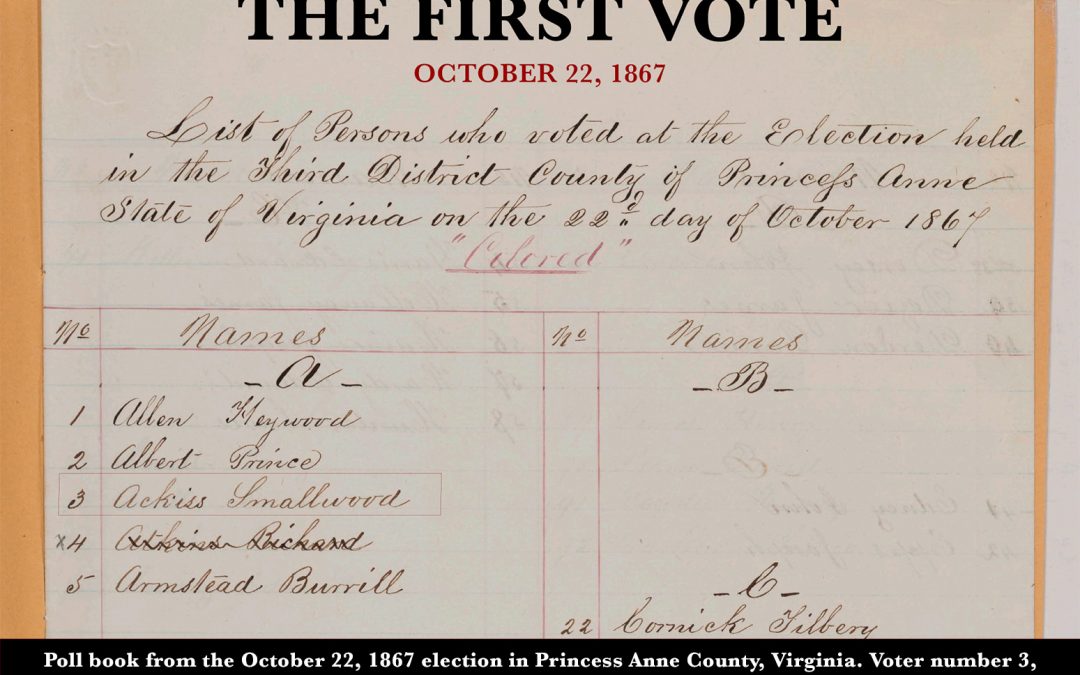
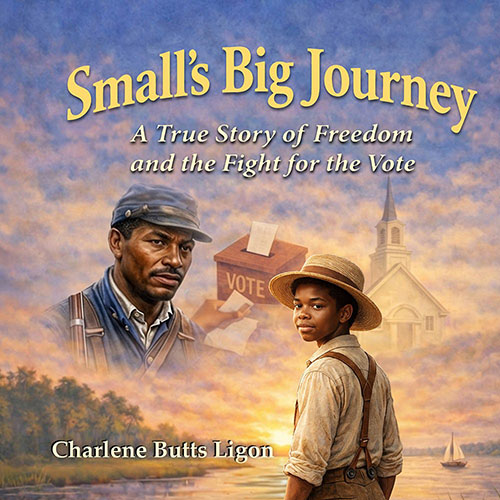
I think about my great-great-grandfather, Smallwood “Small” Ackiss, who was born into slavery and, after the Civil War, became one of the first Black men in his community to vote, something that was not given but claimed at great cost.

I also think about his great-granddaughter, Evelyn Butts, who challenged the poll tax all the way to the Supreme Court and helped end a system that made people pay to vote.

That history is not distant to me, it is my family, and that is why today’s decision lands the way it does.

The Court has made it harder to challenge voting maps that weaken the power of minority voters, because what once could be shown through a harmful effect will now often require proof of intentional discrimination.

Anyone who understands our history knows how difficult that is, because discrimination has rarely announced itself plainly and has instead adapted, using neutral language while producing unequal results.

This decision does not erase the right to vote, but it changes how that right is protected, and for me, that is where the concern lies.

From Small’s first vote to Evelyn’s fight, the lesson has always been the same: access alone is not enough, protection matters, participation matters, and vigilance matters.

We have seen barriers before, some obvious and some carefully constructed, and the question now is not only what the Court has done, but what we do next, how we participate, and whether we choose to use the rights that so many fought to secure.

We Fought for the Right to Vote—Now We Have to Use It

We Fought for the Right to Vote—Now We Have to Use It

We Fought for the Right to Vote—Now We Have to Use It

Black communities in this country understand something deeply:

What it means to be denied the right to vote.

Poll taxes. Literacy tests. Intimidation. Barriers that were not subtle—they were designed to keep people out.

That history is not distant. It is remembered. It is lived through family stories, through community memory, through real experience.

People fought against those barriers.

Some risked their lives. Some lost them.

And because of that struggle, the door to participation was opened.

That matters.

But here is the question we have to ask ourselves now:

What are we doing with that access?

Today, we have more ways to vote than ever before.

You can vote early.
You can vote by mail.
You can vote on Election Day.

Information is available in more places than ever before.

And yet, participation is still not where it should be.

We cannot ignore that.

We know what voter suppression looks like.

So when access exists, we also have to recognize responsibility.

Because the fight was never just about removing barriers.

It was about making participation possible.

And once it is possible, it has to be used.

We cannot honor that history by standing still.

We honor it by showing up.

By paying attention.

By participating.

Because the right to vote is not just something that was won.

It is something that must be exercised.