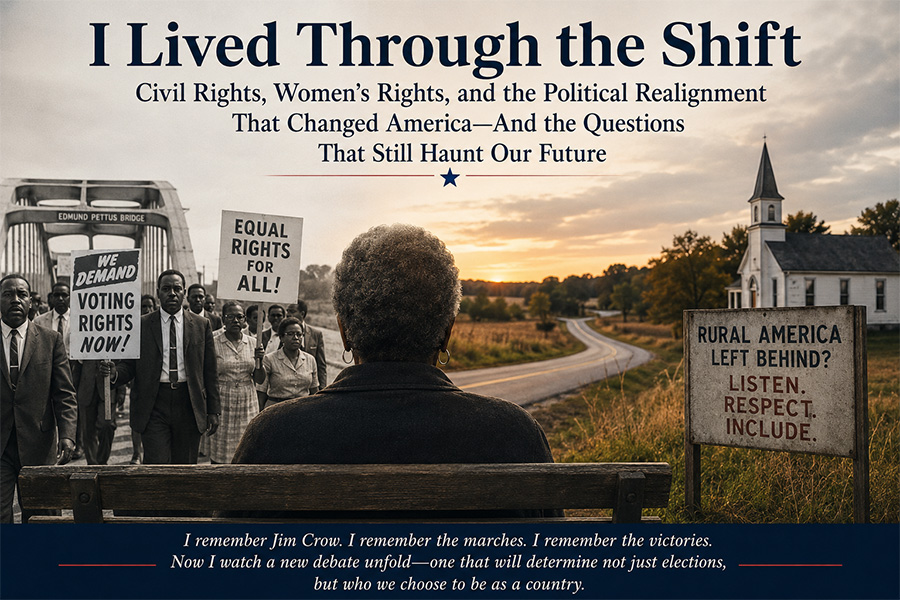
I have been thinking deeply about the conversations happening inside the Democratic Party and how much of it connects to changes I have witnessed during my lifetime. This is a personal reflection from someone who lived through the Civil Rights era and watched the political realignment that followed.
For many Americans, the political realignment that followed the Civil Rights era is something they learned about in school or read about years later. For me, it unfolded in real time.
I was born into Jim Crow America. I grew up in a country where segregation was legal and opportunities were unequal by design. Black families understood clearly that rights could be restricted, delayed, or denied altogether. In my family, civil rights were never abstract political debates. They shaped everyday life.
I remember the protests. I remember the tension people carried. I remember hearing adults talk about politics not as entertainment, but as something tied directly to whether you could vote, find decent work, or simply be treated fairly.
When the Civil Rights Act of 1964 and the Voting Rights Act of 1965 became law, they changed the country in ways that still shape us today. Those laws were necessary and long overdue, but they also accelerated a political transformation that many Americans are still trying to understand.
When I was young, many white Southern conservatives were still Democrats, even while opposing civil rights reforms. The Democratic Party was a complicated coalition that included people with completely different views on race and equality. But after national Democrats embraced civil rights legislation, many white Southern voters slowly began leaving the party. Over time, many found a political home in the Republican Party, especially as cultural resentment, religion, and fears about social change became stronger forces in American politics.
At the same time, Black Americans increasingly aligned themselves with Democrats because the party, despite its flaws and internal disagreements, had become more associated with protecting voting rights and expanding civil rights protections.
But the shift was never only about race.
As the years passed, the Democratic Party also became more closely associated with women’s rights, reproductive freedom, workplace equality, LGBTQ rights, and broader cultural changes happening across the country. Republicans, meanwhile, increasingly presented themselves as defenders of traditional culture, religion, and small-town identity.
I do not believe Democrats lost support in parts of rural America or the South because equal rights for women were wrong. Women deserved equal opportunity, equal protection under the law, and the ability to make decisions about their own lives. But I do believe many culturally conservative voters began feeling that the Democratic Party no longer reflected their communities, values, or way of life.
Over time, politics stopped being only about economics or government programs. Identity, religion, culture, and belonging became just as powerful in shaping how people voted and where they felt politically at home.
Today, I hear many Democrats discussing how to reconnect with working-class voters, rural communities, and Middle America. I understand why those conversations are happening. A political party cannot remain competitive if it loses the ability to connect with large parts of the country.
But I also carry another concern.
I worry about what lessons some leaders may take from recent election losses.
Will the party begin to view civil rights, diversity, inclusion, or women’s rights as political liabilities instead of moral commitments? Will some conclude that the very groups who became central to the modern Democratic coalition are now somehow expendable? Will efforts to regain culturally conservative voters come at the expense of people who spent generations fighting simply to be treated as full participants in American democracy?
Those questions matter deeply to me because I have lived long enough to know that progress can move backward.
I remember poll taxes. I remember segregated schools. I remember a time when Black Americans were told to wait patiently for rights that others already enjoyed. I remember when women had fewer protections, fewer opportunities, and fewer choices about their own lives.
None of those changes happened automatically. People organized, marched, spoke out, and pushed this country to live up to its promises. Some lost jobs. Some lost relationships. Some lost their safety. Some lost their lives.
That history is why I become uneasy when conversations about civil rights or women’s rights are reduced to electoral strategy or “messaging problems.”
At the same time, I do not believe Democrats can afford to dismiss the frustrations of rural or working-class Americans either. Most people want to feel respected. They want to feel seen. They want to believe there is still a place for them and their communities in the country’s future.
The challenge facing Democrats now is larger than simply winning the next election. The challenge is whether the party can build a coalition broad enough to compete politically without abandoning the principles and people that helped define it in the modern civil rights era.
That balance will not be easy.
But for those of us who lived through the beginning of this transformation, these debates do not feel theoretical. We have already seen how quickly this country can divide itself over who belongs, whose rights matter, and whose voices deserve to be heard.
And many of us worry that America may be entering another one of those periods again.