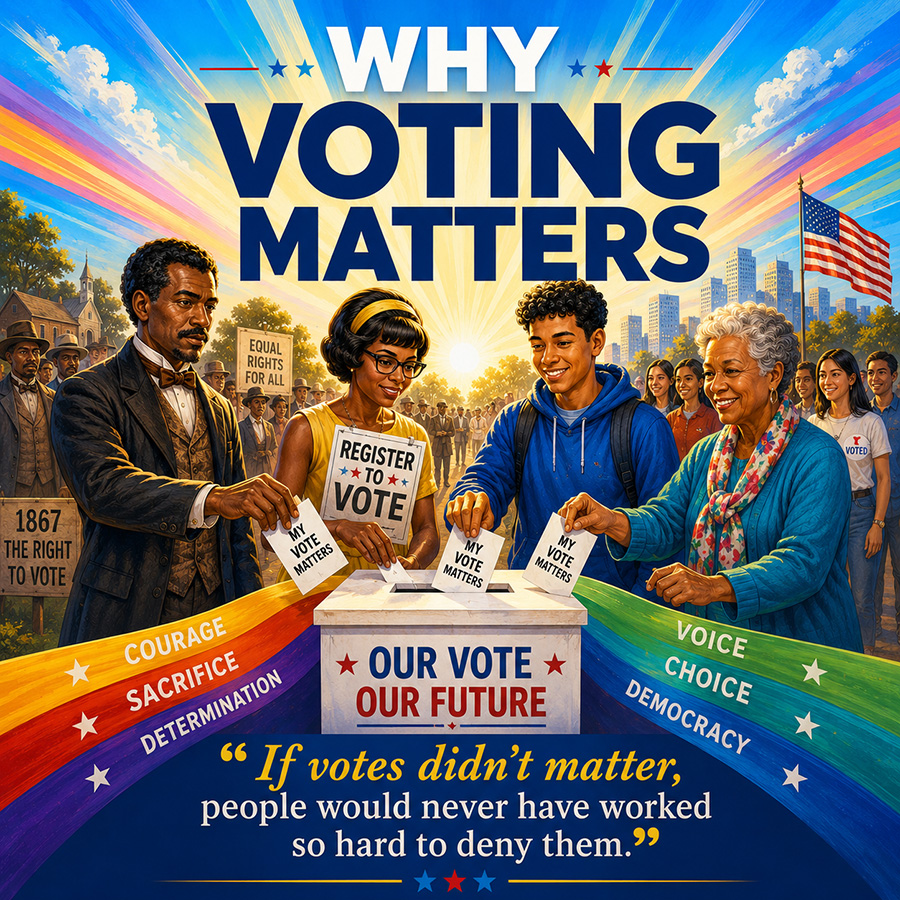
"If votes didn't matter, people would never have worked so hard to deny them."
People often ask why voting matters.
For me, the answer is personal.
It is personal because I know the names of the people in my family who were denied the vote. I know the names of those who fought to protect it. And I know what it feels like to spend years encouraging others to use a right that so many Americans take for granted.
When I began researching my great-great-grandfather, Smallwood Ackiss, I was searching for family history. What I found was something much larger.
In an 1867 poll book from Princess Anne County, Virginia, I found his name.
"Ackiss, Smallwood."
More than 150 years after the election, I was looking at the official record of my great-great-grandfather's first vote.
That moment carried enormous meaning.
Just a few years earlier, Smallwood had been enslaved. Like millions of other African Americans, he had lived in a country where he could be bought, sold, and denied the most basic rights of citizenship. Yet on October 22, 1867, he stood in line with other newly enfranchised Black men and cast a ballot in an election that would help shape Virginia's future.
I often wonder what he was thinking that day.
Did he understand how historic the moment was? Did he realize that future generations of his family would still be talking about that vote more than a century later?
I know what that vote means to me.
It reminds me that voting is not merely a political act. It is an act of citizenship. It is a declaration that your voice matters.
My mother, Evelyn Butts, understood that.
By the time she came of age, African Americans technically had the right to vote, but Virginia had found other ways to make voting difficult. The poll tax required citizens to pay before they could cast a ballot. For many families, especially poor families, it was one more barrier standing between them and full participation in American democracy.
My mother refused to accept that.
She registered voters. She educated citizens about their rights. And when the opportunity came, she challenged the poll tax itself. Her lawsuit became part of the Supreme Court case that ended the poll tax in state and local elections.
She often reminded people that rights mean very little if citizens are unable or unwilling to exercise them.
Years later, I found myself carrying that lesson into my own life.
While living in Nebraska, I spent years registering voters and encouraging people to participate in elections. During one voter registration drive in 2008, I spoke with a young man who had attended school with my youngest daughter.
He told me his vote did not matter.
He believed that the people in power did not care what he thought.
I understood his frustration, but I also thought about Smallwood Ackiss and Evelyn Butts.
Smallwood had lived in a world where he could not vote.
My mother had lived in a world where voting came with obstacles deliberately designed to discourage participation.
This young man lived in a world where the challenge was different. The obstacle was not slavery. It was not a poll tax. It was the belief that participation would make no difference.
That conversation has stayed with me for years.
Every generation faces its own challenges. The barriers change. The arguments change. The frustrations change.
But the question remains the same. Will we participate?
Voting does not guarantee that we will get the outcome we want. It does not guarantee that elected officials will always make the right decisions. It does not guarantee that our side will win.
What it does guarantee is that we have a voice.
When I think about my great-great-grandfather casting his first ballot in 1867, I am reminded that voting is both a right and a responsibility. When I think about my mother challenging the poll tax, I am reminded that every generation must protect that right. And when I think about the young man in Nebraska, I am reminded that the greatest threat to voting is often the belief that it no longer matters.
I disagree.
It mattered to Smallwood Ackiss. It mattered to Evelyn Butts. And it still matters today.
"If votes didn't matter, people would never have worked so hard to deny them."