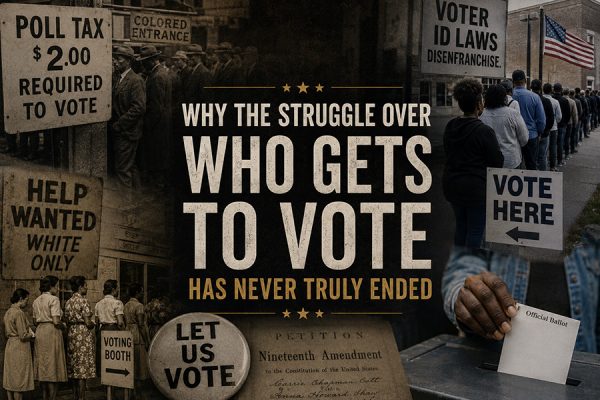
Voting rights are rarely lost all at once. They erode quietly, through small changes, fading memory, and the belief that progress is permanent. History suggests otherwise.
In the United States, the right to vote has never simply existed. It has been defined, restricted, contested, and reclaimed across generations.
At the nation’s founding, political power rested in the hands of white male property owners. The vote was not designed to include everyone; it was designed to preserve influence among those who already held it. Democracy, in its earliest form here, was deliberately narrow.
Over time, that boundary shifted, but never easily and never without resistance.
After the Civil War, Black men were granted the right to vote through the Fifteenth Amendment. Almost immediately, that right was met with obstruction. Laws, intimidation, and violence followed. Literacy tests, poll taxes, and legal barriers did not emerge by accident; they were constructed to limit participation while preserving the appearance of democracy. The Constitution promised citizenship. Practice often enforced exclusion.
Women secured the vote in 1920 after decades of organizing and sacrifice. Native Americans were recognized as citizens in 1924, yet many still faced barriers that delayed meaningful access to the ballot. Every expansion of democracy required pressure. None of it was freely given. None of it was guaranteed to last.
History shows a consistent pattern: democracy expands when forced and contracts when vigilance weakens.
In our own time, debates over voting rules and access have again moved to the center of public life. Supporters describe these measures as necessary protections. Critics recognize an older dynamic: rules that, whether intentionally or not, narrow participation. When participation narrows, power concentrates. That pattern is not new.
Ignoring the role race has played, and continues to play, does not erase disparities. It allows them to persist without scrutiny. Progress, once achieved, does not sustain itself. It must be defended.
I learned this not first from history books, but from watching those before me understand that a barrier to the ballot is never merely administrative. It is a decision about whose voice carries weight.
This is not a partisan claim. It is a historical one.
Rights in the United States are rarely stripped away in a single act. More often, they erode gradually, through incremental rules, shifting requirements, and the quiet assumption that the work is finished. Each generation inherits both the gains and the unfinished obligations of the last.
Democracy has become more inclusive over time. That is undeniable. But history asks a harder question: will we recognize when the boundary begins to move again?
A democracy survives through participation, vigilance, and memory.
The right to vote has always been contested. When memory fades, erosion begins quietly and incrementally, often without announcement. Rights are rarely lost in a single moment; they are worn down over time.
The ballot is more than a procedure. It is the measure of who belongs and whose voice carries power.
When citizens stop watching, boundaries shift. When they remain attentive, democracy endures.
In the months ahead, we will be reminded again that barriers to the ballot are never abstract. They shape real lives, real voices, and the direction of a nation.
History does not repeat itself exactly, but it does follow patterns. The direction it moves, as it always has, depends on whether people choose to notice.